The category is not a single thing
When someone says "Marvel Rivals cheats" they could mean any of five totally different categories of software. A coaching app that analyses your replays after the match is in the same Google results as a forum-leaked aimbot that locks onto enemy heads at sub-frame precision. Both come up under "Marvel Rivals cheats." Neither is the same product. The risk profile, the legality, the effect on your gameplay, and the kind of player they serve are all different.
This post is the honest map of that spectrum. We're going to walk through the five distinct categories of "tools that make you better at Marvel Rivals" — from coaching software that no one considers cheating to the most aggressive autoplay tools — and explain what each actually does, who it's for, and what the trade-offs are.
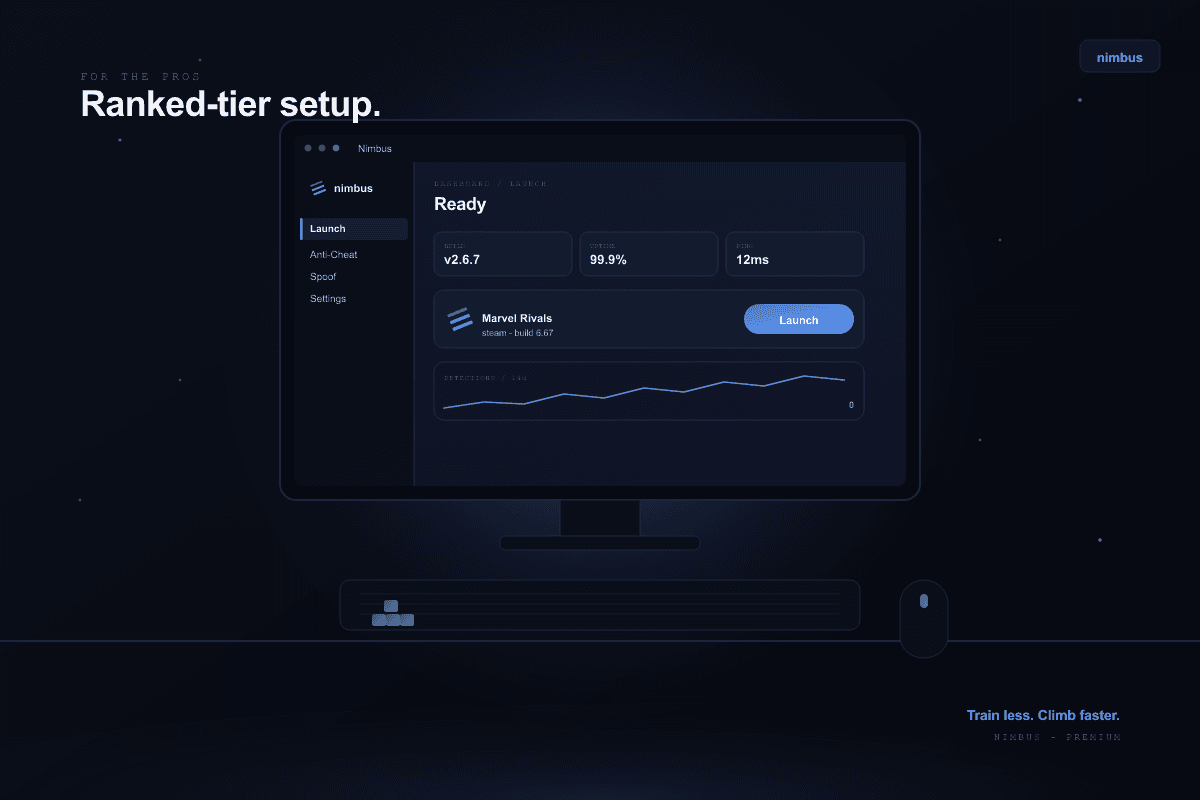
We sell an overlay (Nimbus), so we're going to be specific about where we sit on this spectrum and where we don't. The point isn't to pretend we're a coaching app or to deny we're a tool. The point is to be honest about the categories so you can make an informed choice about what you actually want.
The five categories, in order
From least intervention to most:
- Coaching tools — replay analysis, post-game stats, improvement plans.
- Information overlays — read-only data the game already has (cooldowns, ult charge, teammate stats), surfaced more visibly.
- Decision support / hero-aware overlays — adds analytical computation on top (projectile lead, target ranking) but leaves all input to the player.
- Assisted-aim overlays — applies sub-conscious nudges to the player's input (smoothing, snap-to-target on click).
- Full autoplay / aimbots — the game effectively plays itself. Aim, target selection, and fire timing are automated.
Each step up adds capability — and adds risk, both to the account and to the fairness conversation. Let's walk through them.
Category 1: coaching tools
The least controversial category. Coaching tools work outside the game. They:
- Upload your replays (either from your local saved files or via manual screenshot of the post-match screen) to a service that analyses your decisions and gives you feedback.
- Provide structured improvement plans — "you died to flank pressure 60% of the time on Konoha; here are the angles to watch."
- Sometimes include live overlay elements that show your stats during play, but only YOUR stats, not the game state.
Coaching tools are essentially indistinguishable from "watching a high-level player's stream and taking notes." They don't read game memory, don't talk to the game process, and don't change what happens in the match. They are the kind of software that's completely safe and that no one calls cheating.
The tradeoff: you have to do the work. A coaching tool tells you what to do better; you still have to execute it in your next match. For a player willing to study, they're the highest-value product per dollar. For a player looking to climb without studying, they don't do anything.
Category 2: information overlays
The next step up. Information overlays read game state — the public, visible information the game already shows — and surface it more prominently or in a different layout.
What they typically show:
- Ability cooldowns for enemies you can see. (Visible information; the game itself shows enemy ult charge above enemy heads.)
- Health and shield states, in HUD form rather than as in-game character art.
- Map awareness — pinging enemy positions you've already seen.
The line that defines this category: they show you information the game already exposes. They don't see through walls. They don't track invisible enemies. They don't aim for you.
The argument for this category being acceptable is straightforward: nothing it shows is information you couldn't have memorised. The argument against is that making it easy is a meaningful change to the gameplay experience even if the underlying information was "available."
Marvel Rivals' EULA prohibits this category — it considers "unauthorised tools to gain advantage" a violation regardless of how passive they are. So even at this category, you're outside the official rules. The question of whether the game's anti-cheat will detect you in this category is a separate one from whether the rules permit you.
Category 3: decision support / hero-aware overlays
This is the category Nimbus sits in. The defining capability: the overlay does computation on the game state, not just display.
What that looks like in practice:
- Projectile lead solver — for Hawkeye, Hela, Black Widow, and other arc/projectile heroes, the overlay computes the aim point that would intercept a moving target. The math exists (see our Hawkeye guide) and humans can do it in their heads with practice. The overlay does it for you, every frame.
- Target ranking — among the visible enemies, which is the highest-priority target right now? (Lowest health? Highest threat? Best line-of-sight?)
- ESP with cooldown and ult charge — same as Category 2, but with the analytical layer that tells you which enemy is about to ult next.
What separates this category from the next: the player is still making every decision. The overlay computes; the player acts. The aim suggestion is shown; you still have to click. The target ranking is shown; you still have to point.
The framing matters. A category-3 overlay is a decision-support system — the same kind of tool a chess analysis engine is. It shows you what a stronger player would do. It doesn't make the move for you.
Of course, this category is still EULA-prohibited and still anti-cheat-relevant. We're not arguing it's permitted. We're arguing it's a meaningfully different kind of product than the two categories above.
Category 4: assisted-aim overlays
The step where input automation enters the picture. Assisted-aim overlays modify what the player's input does — not by computing data, but by literally adjusting where the cursor goes.
Common features:
- Aim smoothing. When the player's cursor moves toward an enemy, the overlay slows or curves the motion to keep it on the enemy.
- Snap-on-fire. When the player clicks fire, the overlay snaps the cursor to the nearest enemy head before the shot registers.
- Mouse-event injection. The overlay directly writes mouse movement events to the OS input queue.
This is the category where the "I'm still playing" argument starts to wear thin. You're clicking, but the overlay is doing the aim. The fire timing is yours; the precision isn't.
The risk profile escalates significantly at this category, both in terms of anti-cheat detection (sub-frame snap-to-target is very easy to flag as a heuristic) and in terms of how the gameplay feels to the players around you.
Category 5: full autoplay / aimbots
The category most people think of when they hear "Marvel Rivals cheats." The overlay does everything:
- Reads game memory to find every enemy.
- Picks targets based on its own priority algorithm.
- Aims at them.
- Fires.
- Sometimes ult-detects and times its own ability use.
At this category, the player is essentially watching. Movement is still manual (usually); aim and fire are not.
Aimbots are the highest-detection-risk category, the highest ban-rate category, and the highest "ruining the game for everyone else" category. The vast majority of forum-leaked Marvel Rivals cheats are in this category — because that's what the audience buying $5-on-a-forum cheats wants.
If you're shopping for an overlay, recognising this category and staying away from it is the single best decision you can make for the longevity of your account.
Where Nimbus sits, specifically
We're a Category 3 product. The defining lines:
- The aim solver computes the intercept point for projectile heroes. It does not move your mouse for you. It does not click for you. The aim engine is a suggestion overlay; the input is yours.
- The ESP shows information about cooldowns, ult charge, and positioning. It does not auto-fire at the targets it surfaces.
- The hero-aware features (auto-lock, hero-specific tweaks) operate in champion select and lobby flows, not in mid-match combat decisions.
We are not a Category 1 coaching tool — we read game state, which puts us outside what EAC permits. We are not a Category 2 pure information overlay — we do analytical computation, not just display. We are not a Category 4 assist tool — we don't move your mouse. We are not a Category 5 aimbot — most obviously.
The framing we use internally and externally: decision support, not autoplay. That phrase isn't a marketing line; it's the specification. The overlay tells you what a high-level projectile-lead computation says the intercept point is. You choose whether to take the shot.
What this means for the ban question
Different categories have different detection profiles.
- Category 1 is detected only if you do something dumb (manually copy-paste replay data in a way that ties to your account in a forbidden way). The detection risk is essentially zero.
- Category 2 has low detection risk for the read-only surface but higher risk for the injection method that gets it there. A clean injection of an information overlay is usually undetected; a sloppy one isn't.
- Category 3 has moderate detection risk that depends almost entirely on the engineering of the overlay, not on the features. A well-engineered Category 3 overlay can stay undetected for months; a poorly-engineered one is detected immediately.
- Category 4 has high detection risk because the input- injection patterns are heuristically distinctive. Aim that snaps to head shots at sub-frame precision is the textbook anti-cheat heuristic flag.
- Category 5 has the highest detection risk, often within hours of a leak or a build appearing on a forum.
There's no escape from the fundamental tradeoff: more intervention is more detectable. A coaching tool that just shows you stats can't really get caught. An aimbot that picks the target for you absolutely can. Category 3 sits in the middle, and the engineering quality of the specific product determines whether you're on the "stays undetected" side or the "detected in two weeks" side.
We wrote up how Marvel Rivals' anti-cheat actually works as a deep-dive on this question. The TL;DR: EAC + NEP is a mature, well-engineered detection stack; the way overlays get caught is a function of how the overlay is built, not what features it has.
Picking a category for yourself
If you're trying to decide which category fits you, ask yourself:
- Do I want to put in the work? If yes, Category 1 is underrated. A coaching tool with discipline beats a Category 3 overlay used by an indisciplined player.
- Am I okay with the EULA implications and detection risk? If the answer is "no, at all," then Category 0 — none of these — is the right answer. Some players genuinely don't want any of this. That's a valid choice.
- Am I looking for execution help or for the game to play itself? If the former, Category 3 is what you want. If the latter, you're looking at Category 5 and the very high ban risk and broken-experience tradeoff that comes with it.
The category-3 customer is, in our experience, the player who:
- Already enjoys the game.
- Already practices and improves.
- Wants the cognitive load reduced on the executional parts of projectile mechanics, target prioritisation, and information awareness.
- Wants their actual decision-making — when to push, when to peel, when to ult — to remain theirs.
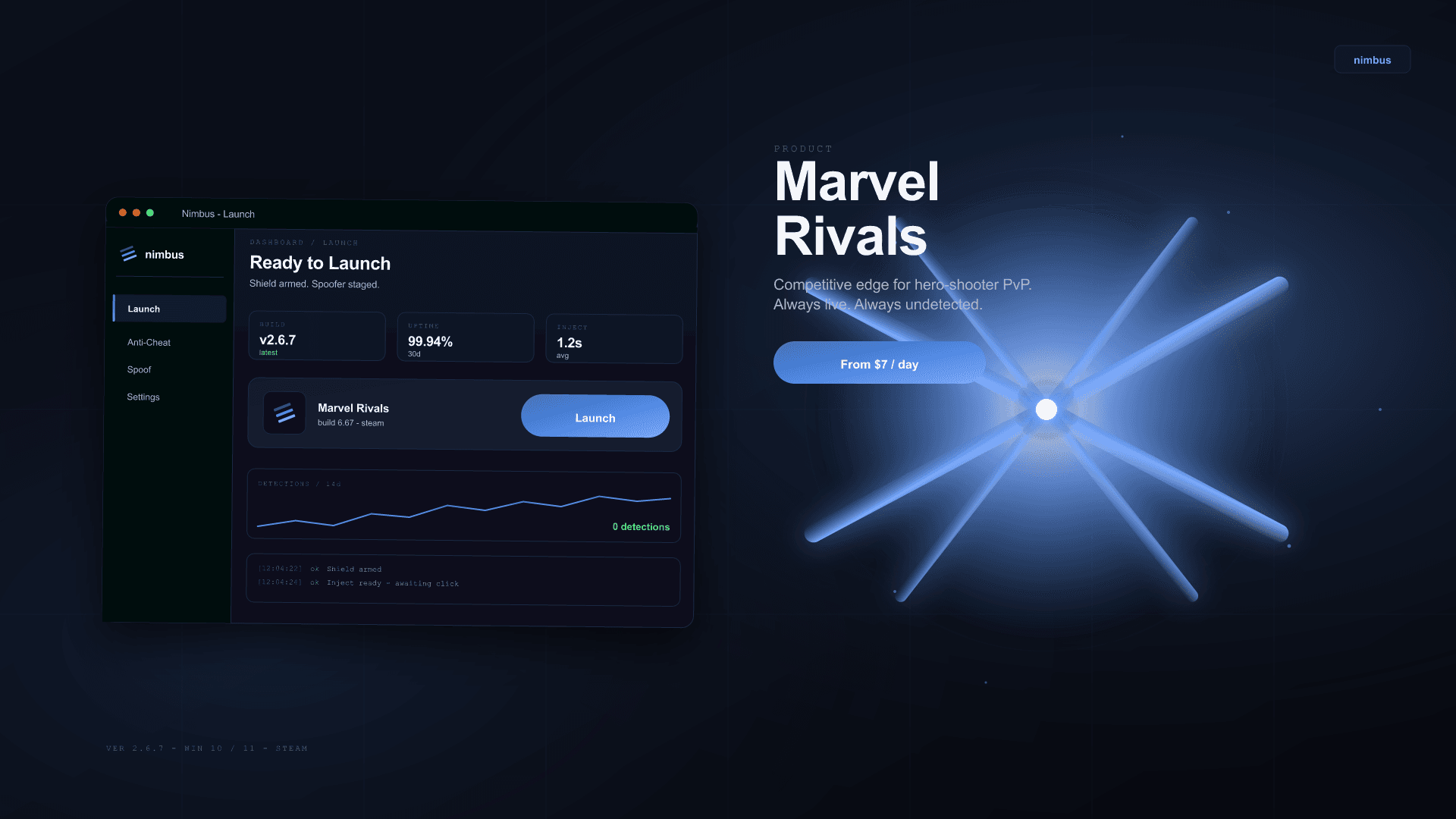
If that's you, our Marvel Rivals product page has the full feature list. Pricing is on the same page. We publish a compare table that puts us next to alternatives, and we maintain a status page for current detection state and a changelog for ship cadence.
If you're new to this space, the overlay safety post is worth reading before any purchase, ours included.
Bottom line
"Marvel Rivals cheats" is a five-category spectrum. The categories have meaningfully different risk profiles, capabilities, and ethical positions. Lumping them together makes for a worse conversation than splitting them apart does.
Coaching tools and pure information overlays are at one end. Full aimbots and autoplay tools are at the other. Decision-support overlays sit in the middle — they compute, but they don't act. That's the category Nimbus sits in, and we think it's the most defensible product position for the kind of player who actually wants to keep improving.
The decision is yours. The honest version is that you have choices, the categories matter, and the right pick depends on what you actually want from the time you spend playing.
If you want to see what a decision-support overlay actually looks like in practice, the full feature list at /products/rivals is the best place to start.